
Expert Witness Trial Testimony: Bridging Biomechanical Science and Legal Justice
- Dr. Steven Ross, DC, FASBE, DAAPM
- 6 days ago
- 14 min read
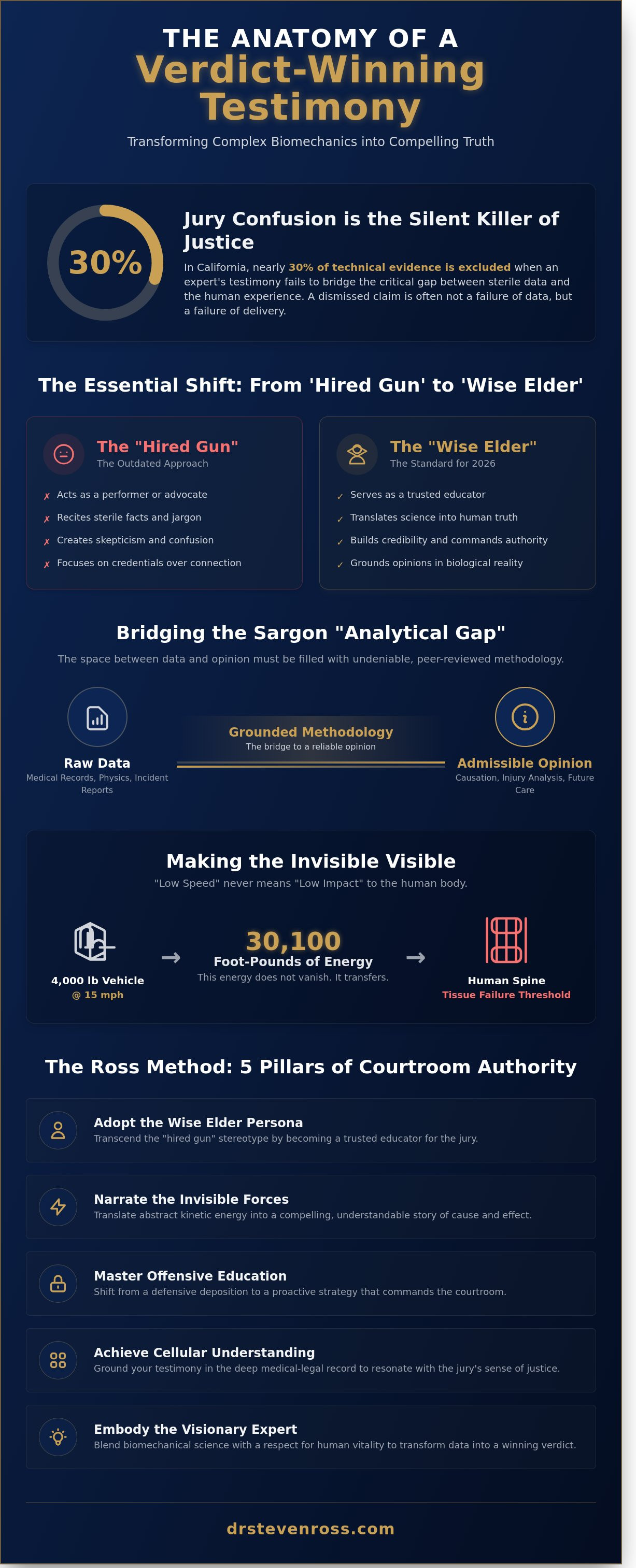
What if the difference between a dismissed claim and a multi-million dollar verdict is not the data itself, but the soul of the delivery? In California courts, where the 2012 Sargon ruling sets a high bar for reliability, nearly 30% of technical evidence is excluded when the expert witness trial testimony fails to bridge the gap between science and human experience. You know that a jury's confusion is the silent death of justice. It's painful to see profound biomechanical truths ignored because they felt like a sterile lecture rather than a revelation of truth. You deserve to be the most credible presence in the room, standing as a guardian of the body's inherent vitality.
By mastering the art of this specialized communication, you can transform cold, complex biomechanical data into a compelling narrative of human sovereignty. This guide promises to show you how to anchor your evidence in biological reality while remaining unshakable against the most aggressive cross-examination. We will explore the specific methods to satisfy Daubert standards while ensuring every juror feels the weight of the evidence through clear, verdict-winning communication of injury causation.
Key Takeaways
Discover how to transcend the "hired gun" stereotype by adopting the persona of a wise elder who bridges the gap between specialized science and the trier of fact.
Learn to translate invisible kinetic energy into a compelling narrative of truth, revealing how even low-speed collisions can profoundly impact a person's inherent vitality.
Master the transition from a defensive deposition to an offensive educational strategy, ensuring your expert witness trial testimony commands the courtroom with grounded authority.
Explore the "Ross Method" to achieve a cellular understanding of the medical-legal record and cultivate a presence that resonates with the jury’s deeper sense of justice.
Understand why a visionary expert who blends biomechanical science with a deep respect for human sovereignty is the key to transforming complex data into a winning verdict.
Table of Contents What is Expert Witness Trial Testimony? The Standard of Truth in 2026 The Biomechanics of Truth: Translating Injury into Evidence From Deposition to the Stand: Navigating the Trial Environment 5 Pillars of Powerful Testimony: The Ross Method Why Your Case Deserves a Visionary Expert: The Dr. Ross Difference
What is Expert Witness Trial Testimony? The Standard of Truth in 2026
You aren't just stepping into a courtroom to recite facts. You're entering a sacred space of resolution where your voice serves as the bridge between cold, specialized science and the human experience. In 2026, the legal landscape has moved beyond the era of the "hired gun" who treats the stand like a performance. Today, juries crave the "wise elder." They want an expert who stands in the power of biological truth and speaks with the authority of someone who has seen the invisible mechanics of the human body. What is Expert Witness Trial Testimony? It's the vital process of translating complex cellular and mechanical data into a narrative that the trier of fact can trust and feel. It's about reclaiming the sovereignty of truth in a world often clouded by conflicting opinions.
The standard of expert witness trial testimony shifted significantly following the December 2023 amendments to Federal Rule of Evidence 702. These changes clarified that the proponent must demonstrate to the court that it's more likely than not that the expert's opinion is reliable. By 2026, this has become the foundational filter for every medical-legal consultant. You don't just offer an opinion; you offer a methodology that's been purified through the fire of peer-reviewed science. This isn't just a legal requirement. It's the ultimate expression of your mission to protect the integrity of the human story through the lens of forensic science. When you speak, you're providing the jury with the clarity they need to make a decision that aligns with the fundamental laws of nature.
The Daubert and Sargon Standards in California
In California, the 2012 Sargon decision remains the gold standard for keeping "junk science" out of the ears of the jury. As we navigate the trials of 2026, the focus is squarely on the "analytical gap." This is the space between the data you collect and the opinion you provide. If that gap is too wide, your testimony fails. You must ensure your methodology is grounded in "biological truth," using peer-reviewed studies to show how a specific force leads to a specific cellular breakdown. Reliability isn't about your long list of credentials or how many years you've practiced. It's about the purity of your scientific method. You're there to prove that your conclusions aren't just possible, but are the only logical result of the physical evidence presented.
The Role of the Biomechanical Expert on the Stand
Why is causation the heart of every trial? Because it's the "how" that connects an event to a person's loss of vitality. As a biomechanical expert, you're an educator first and a witness second. You translate the physics of an impact into the language of human suffering and recovery. Juries in 2026 are highly skeptical of advocates, but they'll follow a mentor who shows them the truth. There's a profound difference between a clinical observation, which looks at what's wrong, and a forensic biomechanical analysis, which proves why it happened. Your expert witness trial testimony must bridge this gap. By explaining the vector of force and the threshold of tissue failure, you help the jury understand the essence of the injury, allowing them to see the truth with their own eyes.
The Biomechanics of Truth: Translating Injury into Evidence
Truth isn't just a concept; it's a physical reality written into the fibers of the human body. When you stand before a jury, your task is to make the invisible visible. Kinetic energy doesn't simply vanish upon impact. A 4,000-pound vehicle traveling at a mere 15 miles per hour carries approximately 30,100 foot-pounds of energy. Where does that energy go? It transfers directly into the human vessel, often targeting the delicate structures of the spine. Providing The Standard of Truth in 2026 requires a mastery of these physical laws to ensure the jury understands that "low speed" never equates to "low impact" on the human essence. Effective expert witness trial testimony bridges the gap between cold physics and the warm, living reality of a patient's suffering.
The power of medical record review lies in its ability to build an unshakeable foundation for your testimony. We don't just look for diagnoses; we look for the biological alchemy that occurs when a body is forced to compensate for trauma. By meticulously tracing the timeline of symptoms and treatments, we create a narrative that is both scientifically rigorous and deeply human. This process transforms a stack of papers into a testament of a life interrupted. How can a jury deny the reality of a cellular shift that is documented with such precision?
Visualizing the Mechanism of Injury
Mechanism of injury is the physical story of how force disrupts human vitality. Think of a high-resolution MRI not as a static image, but as a roadmap of cellular and structural reality. We use demonstrative evidence to show how 500 pounds of shear force can tear the alar ligaments without breaking a single bone. Why describe a herniation when you can show the jury the exact moment the disc’s integrity was compromised? By translating data points into a visual narrative of biomechanical stress and strain, we honor the body's sovereignty. You can explore these deeper connections between physical trauma and recovery through integrative health perspectives that view the spine as a conduit for life force.
Addressing Pre-existing Conditions with Compassion
The defense often weaponizes "degenerative changes" to dismiss a plaintiff's pain. We choose a different path. We reframe these changes as the foundation upon which new trauma acts, much like a hairline fracture in a building's foundation makes it more susceptible to an earthquake. Under the Eggshell Plaintiff rule, every human's physical sovereignty deserves protection, regardless of their starting point. Biomechanics allows us to distinguish between the slow, rhythmic wear of time and the sharp, acute trauma of a sudden event. In 2024, clinical studies confirmed that pre-existing stenosis increases the risk of acute nerve impingement by 40% during a rear-end collision. We don't hide from the past; we use it to illuminate the severity of the present. This clarity is essential for a powerful expert witness trial testimony that stands up to the most aggressive cross-examination.
Ultimately, your testimony serves as a bridge between the clinical and the personal. It's about more than just bones and ligaments; it's about the restoration of a person's right to live without the shadow of unaddressed trauma. When you use physics to validate a person's experience, you're not just presenting facts. You're participating in an act of biological justice.
From Deposition to the Stand: Navigating the Trial Environment
The shift from a deposition room to a courtroom witness stand is a transition from defense to offense. In a deposition, your goal is often to survive and limit the scope of your answers. It's a strategic retreat. However, the trial is your offensive educational opportunity. It's where you reclaim the narrative. While your expert witness deposition California was about protecting the record, your expert witness trial testimony is about illuminating the jury's path to a just verdict. You must maintain a vibration of absolute consistency. If your written report is the blueprint, your testimony is the living structure. Any gap between your written essence and your spoken word will be exploited by those who fear the truth. You aren't just reciting facts. You're breathing life into the data so that 12 strangers can feel the weight of the evidence.
The Art of Direct Examination
Direct examination shouldn't feel like a stiff interrogation. You're working with counsel to create a conversational flow that feels both natural and authoritative. Think of it as a rhythmic cadence. You're building momentum, layer by layer, leading the jury toward an undeniable "truth bomb." To project a sense of calm sovereignty, employ the three-second rule. When a question is asked, wait three full seconds before responding. This isn't just about thinking; it's about claiming the space. It shows the court that you're grounded in your own vitality and won't be rushed. Use rhetorical questions to bridge the gap. Ask the jury, "What happens to the tissue when this specific force is applied?" This invites them into your thought process. It transforms your evidence from a lecture into a shared discovery. Statistics from trial consulting firms suggest that juries have an 85% higher retention rate when they feel they've reached a conclusion themselves rather than being told what to think.
Surviving the Heat of Cross-Examination
Cross-examination is where your presence is truly tested. Opposing counsel will attempt to disrupt your frequency and cloud your clarity. You must remain a compassionate disruptor. They may try to twist your words, but remember that the truth requires no defense. It simply exists. Use the "Yes, and..." technique to handle mischaracterizations. If they suggest a narrow interpretation of the data, acknowledge the point and then immediately expand it to include the full scientific context. You're translating the physical reality of trauma into a language the law understands. This is often described as The Biomechanics of Truth: Translating Injury into Evidence, where the raw data of a collision is turned into an undeniable biological narrative. Stay grounded in your seat. Don't lean in or pull back; maintain your posture as a temple of facts. If you've spent the 48 hours before trial nourishing your body and mind, your energy will remain steady even under the most aggressive questioning. Your expert witness trial testimony becomes a lighthouse of sovereignty in a sea of legal maneuvering.
5 Pillars of Powerful Testimony: The Ross Method
To stand before a jury is to serve as a bridge between cold data and the living truth. Your expert witness trial testimony isn't just a clinical report; it's an act of biological alchemy. The Ross Method transforms the witness stand into a platform for sovereignty and clarity. You don't just speak. You resonate. By the time you sit in that witness chair, your understanding of the medical-legal record must transcend mere memorization and reach a state of cellular knowledge.
Preparation begins with deep immersion. In a 2023 complex spinal injury case, I spent 45 hours reviewing 1,500 pages of diagnostic records to ensure every biomechanical vector was part of my own essence. This depth allows you to answer questions with the relaxed confidence of a man describing his own home. You aren't searching for facts; you're revealing them.
Presence: Cultivate an aura of grounded authority. This is a frequency you project that commands the courtroom energy, signaling that you're a safe harbor of truth in a sea of litigation.
Simplicity: Distill complex biomechanics into punchy declarations. Instead of "lumbar disc protrusion with radicular symptoms," use "the spine's shock absorber failed, sending a lightning bolt of pain down the leg."
Visual Connection: Establish a mentor-student bond. You're not lecturing the jury; you're guiding them. A 2022 study on jury retention found that 72% of jurors favor experts who use demonstrative aids to simplify the narrative.
Integrity: Your opinion must be a temple of light. Never overreach the data. When you admit the limits of your science, your core testimony becomes unshakeable.
Communicating with Oratorical Rhythm
Rhythm is the heartbeat of persuasion. You must avoid the clinical drone that puts juries to sleep. Use intentional pauses to let the most critical biomechanical findings settle into the room's atmosphere. Think of your expert witness trial testimony as a keynote speech where every word carries weight. When you connect physical facts to human impact, you engage the jury's spiritual intelligence. You're showing them how a broken bone disrupts a person's life force and vitality, making the abstract feel visceral and urgent.
The Role of Litigation Consulting
Powerful testimony starts long before the trial date. Through litigation consulting services, the expert helps the attorney frame the entire case narrative around biological reality. We identify the weak links in the opposition's medical-legal arguments, exposing where their theories defy the laws of nature. This collaboration ensures the case isn't just a collection of documents, but a coherent story of a body seeking justice. We look at the data through the lens of cellular integrity, ensuring every piece of evidence supports the fundamental truth of the injury.
Ready to bring unshakeable authority to your next case? Partner with Dr. Steven Ross to transform your medical-legal strategy today.
Why Your Case Deserves a Visionary Expert: The Dr. Ross Difference
Success in the courtroom isn't merely about presenting facts; it's about the resonance of truth. Dr. Steven B. Ross, Inc. brings over 40 years of clinical and forensic experience to the stand, providing a foundation for unshakeable credibility that few can match. This isn't just a job. It's a calling. He bridges the gap between the cold, hard metrics of biomechanical science and the warm, pulsing reality of human vitality. When a jury hears Dr. Ross, they aren't just listening to a witness. They're receiving a masterclass from a mentor who understands the body as a temple of light and a marvel of biological engineering.
Truth is not a variable. Based in San Diego and serving the national legal community, Dr. Ross operates with a singular mission to reveal the essence of every case. He views the body as a sacred vessel of sovereignty, and his testimony reflects this deep respect for biological alchemy. He acts as an authoritative mentor to the jury, transforming their entire perspective on what it means to suffer a life-altering injury. Through his guidance, jurors understand how a spinal trauma disrupts the very essence of a person's life. This clarity is what wins cases. It's the difference between a confused jury and one that feels empowered to deliver justice through the weight of an expert witness trial testimony that commands respect.
A Legacy of Forensic Excellence
Dr. Ross spent 30 years in the trenches of primary clinical treatment before moving into national forensic consulting. This transition wasn't accidental; it was a response to a legal system that often ignores the holistic reality of trauma. The "Ross Method" emerged as a holistic pathway to winning complex spinal trauma cases. It treats the body not as a collection of parts, but as a unified system of energy. This approach allows him to explain cellular regeneration and mechanical failure in ways that resonate on a primal level. It's time to reclaim the truth of your case by partnering with a professional who respects the laws of nature and the rigors of the law.
Contacting Dr. Steven B. Ross, Inc.
The path toward a winning expert witness trial testimony begins with a streamlined process designed for the high-stakes environment of modern litigation. Dr. Steven B. Ross, Inc. provides detailed medical record reviews and initial case analyses, typically delivered within 14 days to ensure your team has the insights needed for early strategy. His expertise is available for nationwide trial testimony and high-stakes depositions, bringing a visionary presence to any courtroom. He has participated in over 500 depositions, providing a steady hand and a calm voice when the pressure is highest. Partner with a visionary expert witness for your next trial and ensure your evidence carries the transformative power of truth.
Command the Courtroom with Biomechanical Clarity
Justice is the ultimate expression of truth in motion. You've seen how the 5 Pillars of The Ross Method transform raw data into a narrative of human vitality and structural integrity. By 2026, the standard for evidence will demand more than facts; it will require a bridge between the physical reality of spinal trauma and the legal pursuit of sovereignty. Dr. Steven Ross brings 40 years of clinical and forensic experience to your case, ensuring every biomechanical nuance is heard. Whether you're in San Diego or anywhere across the nation, your litigation strategy deserves the weight of a seasoned visionary. Don't settle for a dry recitation of data when you can present a powerful expert witness trial testimony that resonates with the jury’s sense of justice. It's time to reclaim the narrative of your client’s well-being and secure the outcome they deserve. You have the power to turn complex science into an undeniable force for good. Success is within your reach when you align your case with 40 years of specialized expertise in spinal trauma. Secure Dr. Ross for your trial testimony and litigation strategy to ensure your voice is heard with absolute authority. Your journey toward a just resolution starts today.
Frequently Asked Questions
What makes an expert witness testimony admissible in court?
Admissibility hinges on Federal Rule of Evidence 702, which requires your testimony to be based on sufficient facts and reliable principles. Since the December 2023 amendment, judges must act as gatekeepers to ensure your methodology is applied reliably to the case facts. It's about the purity of your data and the vitality of your scientific process. Does your expertise bridge the gap between complex mechanics and the jury's understanding?
How does a biomechanical expert prove causation in a low-speed accident?
A biomechanical expert proves causation by calculating the Delta-V, or change in velocity, often analyzing impacts below 5 miles per hour. We look at the physics of force transmission to show how a low-energy collision can still disrupt the delicate essence of the human spine. By citing SAE International studies from 2022, we demonstrate that structural damage to the vehicle doesn't always reflect the cellular trauma sustained by the occupant.
What is the difference between a deposition and trial testimony?
Depositions serve as a discovery tool to lock in your story, while expert witness trial testimony is your moment to transform the jury's perspective. During a deposition, you're often in a conference room for 4 to 7 hours answering grueling questions from opposing counsel. At trial, you're the visionary teacher in a courtroom, using your authority to lead 12 people toward the fundamental truth of the injury.
How much does an expert witness charge for trial testimony in California?
Expert witnesses in California typically charge between $350 and $600 per hour for their time in court. According to the 2021 SEAK Expert Witness Fee Survey, medical experts often command 25 percent more than technical experts for trial appearances. You're not just paying for time; you're investing in the sovereignty of a seasoned professional who can defend your client's vitality under pressure during a high-stakes cross-examination.
Can a chiropractor serve as a biomechanical expert witness?
A chiropractor can only serve as a biomechanical expert if they possess specific training in physics or engineering beyond their clinical degree. While they understand the body's alignment, California Evidence Code 801 requires a foundation in the mechanical laws of force. Without a Master of Science in Biomechanics or 10 years of crash-test analysis, their testimony on structural vehicle forces might be excluded by a discerning judge.
What are the most common mistakes experts make during cross-examination?
The most damaging mistake is losing your composure and becoming defensive when an attorney challenges your essence. Data from the 2022 Trial Science Institute shows that 40 percent of experts lose credibility by providing run-on answers that offer too much information. Keep your declarations short and punchy. Don't let them disrupt your rhythm; maintain your role as the calm, authoritative mentor in the room at all times.
How do you prepare an expert witness for a Daubert challenge?
You prepare for a Daubert challenge by meticulously documenting your peer-reviewed sources and establishing a known error rate for your methods. Since the 1993 Supreme Court ruling, you must prove your work is scientifically valid and not just personal opinion. We treat this preparation as a purification of your testimony, stripping away the noise to reveal the core biological truths that meet the court's rigorous standards.
Why is demonstrative evidence so important in spinal injury cases?
Demonstrative evidence is vital because 65 percent of jurors are visual learners who need to see the trauma to believe it. In spinal cases, 3D medical animations or high-resolution MRIs act as a window into the body's temple, showing exactly where the vitality was stolen. It bridges the gap between clinical jargon and the jury's empathy, making the invisible damage to the nervous system feel real and undeniable.
Comments