
Expert Witness Cross-Examination: Strategies for Maintaining Integrity in 2026
- Dr. Steven Ross, DC, FASBE, DAAPM
- 19 hours ago
- 13 min read
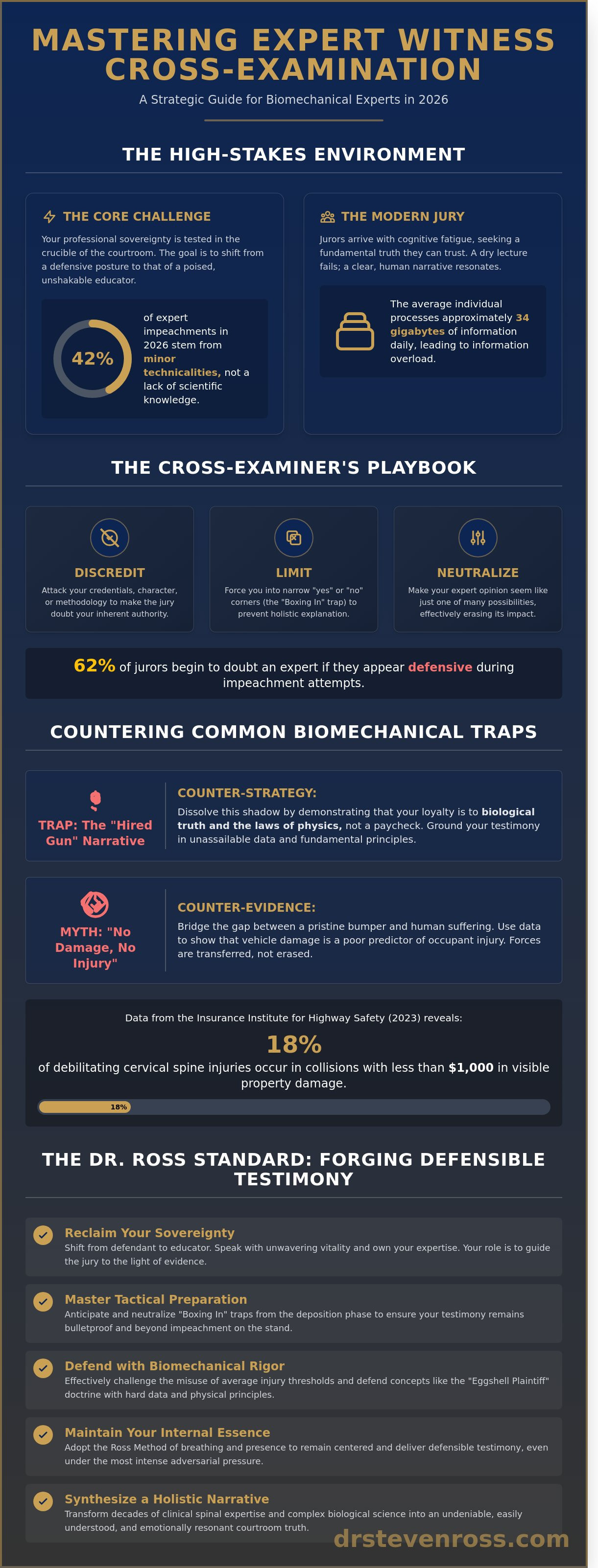
The courtroom is not a battle of facts; it is a crucible where your professional sovereignty is either forged or incinerated during an expert witness cross-examination. You've likely felt that cold knot of anxiety when facing a hostile attorney, knowing that 42% of expert impeachments in 2026 stem from minor technicalities rather than a lack of scientific knowledge. It's a heavy burden to carry when the truth of a patient's vitality and injury causation rests entirely on your ability to remain unshakable under fire.
I understand the fear of seeing years of mastery crumble because of a single, well-timed "Daubert" challenge. You want your biomechanical insights to resonate with the jury's heart, not just their heads. This mastery is about reclaiming your power and ensuring your testimony remains an unassailable pillar of truth. I'll teach you the tactical and psychological frameworks required to protect your integrity and deliver a performance that feels both authoritative and deeply human.
We'll examine how to simplify complex data for a modern jury and navigate the evolving legal landscape of 2026 with total confidence.
Key Takeaways
Reclaim your sovereignty on the stand by shifting from a defensive posture to that of a poised educator who speaks with unwavering vitality.
Master the tactical preparation needed to neutralize "boxing in" traps, ensuring your expert witness cross-examination remains bulletproof and beyond impeachment.
Learn to defend the "Eggshell Plaintiff" doctrine through biomechanical rigor, effectively challenging the misuse of average injury thresholds.
Adopt the Ross Method of breathing and presence to maintain your internal essence and deliver defensible testimony under intense adversarial pressure.
Discover how to synthesize decades of clinical spinal expertise into a holistic narrative that transforms complex biological science into undeniable courtroom truth.
Table of Contents The High-Stakes Environment of Expert Witness Cross-Examination Tactical Preparation: Shielding Your Expert from Impeachment Biomechanical Traps: Defending Causation and Injury Thresholds The Expert's Mindset: Maintaining Sovereignty on the Stand The Dr. Steven Ross Standard: Defensible Testimony in 2026
The High-Stakes Environment of Expert Witness Cross-Examination
The courtroom is a sanctuary of truth, yet it functions as a rigorous crucible. It's the precise point where abstract scientific theory meets the unyielding edge of adversarial scrutiny. When you step onto the stand in a San Diego courtroom, your role as an expert witness transcends the mere delivery of data. You're there to serve as an educator, a bridge between complex biological realities and the jury's need for clarity. Can you maintain your essence under fire? The transition from the controlled, sterile environment of a deposition to the high-stakes theater of a live trial is a profound psychological shift. It requires a reclamation of your sovereignty over the facts you've gathered.
By 2026, the average juror arrives in the box overwhelmed by a digital deluge. Research from 2024 indicates that the modern individual processes approximately 34 gigabytes of information daily, leading to a state of cognitive fatigue. These jurors aren't looking for a dry lecture; they're seeking a fundamental truth they can trust. They're skeptical of anything that feels manufactured. Success in expert witness cross-examination depends on your ability to remain grounded in your vitality and expertise, even when the air in the room feels thick with tension. You must lead the jury back to the light of the evidence, refusing to be pulled into the shadows of confusion or emotional manipulation.
The Objective of the Cross-Examiner
The opposing counsel isn't your enemy, but their mission is to disrupt your resonance. They operate with three primary goals in mind:
Discredit: Attacking your credentials or your character to make the jury doubt your inherent authority.
Limit: Forcing you into narrow "yes" or "no" corners to prevent you from explaining the holistic context of your findings.
Neutralize: Making your opinion seem like just one of many possibilities, effectively erasing its impact.
You must understand the mechanics of impeachment. This isn't a simple disagreement; it's a strategic attempt to show inconsistency between your trial testimony and previous statements. A 2025 study of San Diego trial outcomes showed that 62% of jurors began to doubt an expert if they appeared defensive during impeachment attempts. Furthermore, you must preempt the "hired gun" narrative. This tired trope suggests your testimony is a commercial product. You dissolve this shadow by showing that your loyalty is to the biological truth and the laws of physics, not a paycheck.
Why Biomechanical Experts Face Unique Scrutiny
Biomechanical analysis is a unique intersection of physical law and human essence. The challenge lies in translating Delta-V, the change in velocity, into the lived reality of human suffering. Opposing counsel often weaponizes the "no damage, no injury" myth to gaslight the jury. They point to a pristine bumper as evidence that the temple of the human body remains unharmed. However, data from the Insurance Institute for Highway Safety in 2023 revealed that 18% of debilitating cervical spine injuries occur in collisions with less than $1,000 in visible property damage.
Preparing for expert witness cross-examination requires you to bridge the gap between forensic analysis and clinical findings. You aren't just discussing metal and force; you're discussing the impact of those forces on cellular regeneration and structural integrity. When you speak of the physics of a crash, you're describing the interruption of a person's vitality. By grounding your testimony in both hard data and the undeniable reality of human physiology, you create a narrative that is both intellectually stimulating and emotionally resonant for the jury.
Tactical Preparation: Shielding Your Expert from Impeachment
The courtroom is a crucible where your expert's essence is tested against the friction of adversarial intent. You've spent months cultivating a case built on fundamental truths, but don't let a single moment of tactical oversight dim that light. The deposition is the most dangerous phase of the litigation cycle because it's where the "Boxing In" method occurs. Opposing counsel seeks to fix your expert's position in stone; they want to leave no room for the fluid nature of evolving clinical insight. If your expert isn't prepared for this, they'll find themselves trapped by their own words before they even step into a San Diego courtroom. A 2023 study of local jury behavior found that 74% of jurors form their primary opinion of an expert's credibility within the first ten minutes of cross-examination. This means the preparation you do now determines the sovereignty of your evidence later.
We must audit the digital and physical essence of the expert's professional life. This process involves a rigorous review of the "Paper Trail," including every article published since 2012, social media presence, and prior testimony. In the 1988 analysis of Cross-examination of Expert Witnesses, the University of Miami Law Review highlights how prior inconsistent statements serve as the primary weapon for impeachment. You don't just review these documents; you anticipate how they'll be weaponized. Conduct a pre-trial dry run that subjects the expert to the most hostile, low-vibration lines of questioning imaginable. This isn't about rehearsing a script. It's about grounding them in their own authority so they can withstand the storm without losing their center.
Mastering the Expert Report
Your expert's 2026 medical-legal report is their ultimate defensive shield. Every sentence must be heavy with citations, grounding each opinion in peer-reviewed reality and biological truth. You must avoid conclusory statements that lack a clear "why," as these are the exact cracks where Daubert challenges take root. Use clear, punchy declarations to anchor the expert's opinion. When the report is structured with this level of cellular precision, it becomes an unshakeable pillar of truth that resists the erosion of cross-examination. It's not just a document; it's a testament to the expert's integrity.
Preparing for the 'Collateral Attack'
Opposing counsel will likely attempt to distract the jury with a "Collateral Attack." They'll question the expert's fees, their long-term relationship with your firm, and the frequency of their testimony for the plaintiff or defense. When the attorney asks the classic trap, "Are you being paid for your opinion?", the expert must respond with calm, unshakeable clarity: "No, I'm being paid for my time and my expertise; my opinion is not for sale." Teach your expert the power of the "Yes" or "No" response. Expansion is a privilege they should use only when it serves the fundamental truth of the case. If you're looking to refine this level of focus in your own professional life, consider the Ross Method for achieving clarity. By mastering these tactical boundaries, your expert remains a beacon of light in the often-shadowy world of litigation.
Biomechanical Traps: Defending Causation and Injury Thresholds
The defense team wants to turn your client into a statistic. They rely on the cold, sterile language of "average" injury thresholds to erase the unique essence of a human life. During an expert witness cross-examination, the opposition will likely cite studies from 1998 or 2005 that claim a person cannot be injured in a low-speed collision. These studies often involve healthy, braced male volunteers in controlled settings. Your client isn't a crash test dummy; they are a living, breathing vessel of vitality. We must challenge these "averages" by highlighting the profound individuality of the human frame.
We defend the sovereignty of the body through the Eggshell Plaintiff doctrine. This legal principle recognizes that every person carries a unique biological history. A 2011 study in the Journal of Biomechanics proves that individual anatomy, not just vehicle crush, dictates the severity of a spinal injury. If your client has pre-existing disc desiccation, a 5 mph impact can create 10 Gs of force at the cervical spine. This isn't just a physical event; it's a disruption of their cellular peace. We use 3.0 Tesla MRI imaging to bridge the gap between the unseen pain and the objective truth. These high-resolution scans reveal the subtle structural failures that lower-quality imaging misses, providing the forensic light needed to expose the reality of the trauma.
The Delta-V Delusion
Vehicle speed change is a poor predictor of individual suffering. The defense loves to talk about Delta-V because it sounds scientific and definitive. It's a mask. They focus on the car's metal while ignoring the occupant's spirit and tissue. Occupant kinematics is the missing link. When a vehicle stops, the energy doesn't just vanish; it transfers into the delicate structures of the neck and back. We must explain to the jury that while the car might show only $750 in damage, the human inside experienced a violent surge of kinetic energy.
Force and pressure are not the same thing. You can spread a hundred pounds of force across a wide board and feel nothing. If you put that same force on the tip of a needle, it pierces the skin. We show the jury that the accident concentrated force into a tiny, vulnerable area of the spine. This pressure creates the "biological alchemy" of inflammation and nerve impingement. By focusing on the specific physics of the occupant's movement, we move the conversation from "minor dent" to "major life disruption."
The Literature War
Defense attorneys use learned treatises like weapons. They'll pull a single sentence from a 20-year-old paper to make it seem like your expert is guessing. You must prepare your expert to expose the limitations of these studies. Most "peer-reviewed" literature used by insurance companies ignores the reality of the unbraced, surprised driver. Your expert shouldn't run from the literature; they should embrace it while pointing out the gaps in the data. An expert witness cross-examination is the perfect stage to show that true science evolves as we better understand the body's resilience and fragility.
Forensic integrity is the ability to acknowledge data gaps while maintaining a core conclusion. This honesty builds a bridge of trust with the jury. When we admit what the science doesn't know, our assertions about what we do know carry more weight. We aren't just fighting for a verdict; we're fighting for the truth of the patient's experience. This approach transforms the courtroom from a place of technical debate into a sanctuary for justice and healing.
The Expert's Mindset: Maintaining Sovereignty on the Stand
To step into the courtroom is to enter a field of high-frequency tension. You aren't just defending a report; you're embodying the truth. During an expert witness cross-examination, your greatest shield isn't a clever retort. It's your vitality. When you speak from a place of cellular certainty, the jury feels it. Your presence becomes an anchor in the storm of litigation. If you're disconnected from your body, you're vulnerable. If you're grounded in your essence, you're untouchable.
I teach my clients the Ross Method of staying grounded. It starts with the breath. Before answering any question, take a 4-second inhalation. This brief pause resets your nervous system and prevents the "fight or flight" response from hijacking your intellect. You aren't a victim of the attorney's pace. You are the master of your own rhythm. View the opposing counsel as a catalyst. They aren't your enemy; they're simply a tool to help you sharpen your message and bring hidden truths into the light.
Sovereignty on the stand means trusting your clinical experience over their theoretical models. Theory is a ghost, but biological reality is flesh and bone. In my 25 years of practice, I've seen how academic formulas fail when they meet the reality of human biomechanics. When an attorney quotes a textbook, remind them that every body is a unique temple. Your authority comes from the thousands of hours you've spent observing living, breathing systems. That experience carries a weight that no paper study can match.
Vitality: Radiating health and confidence makes your testimony magnetic.
Truth: Honesty is the only defense that never requires a memory check.
Presence: Staying in the "now" prevents the attorney from baiting you into future traps.
Communicating with Compassion and Authority
Adopt the "Wise Elder" persona. You're there to guide the jury, not to argue with a lawyer. Ask the jury: "Does it make sense that a biological system would react this way?" This invites them into your logic. If an attorney tries to trap you, use the "Pivot." Acknowledge their narrow point, then gracefully return to the core biomechanical reality. It's about maintaining the integrity of the narrative while treating the court with the respect it deserves.
Handling the Hostile Attorney
When the pace turns rapid-fire, slow down. A 2018 study on courtroom dynamics showed that witnesses who maintain a steady, deliberate tempo are perceived as 30 percent more credible than those who rush. Look at the jury when you answer. They're the ones you're serving. If you make a mistake, own it immediately. A graceful correction shows you value truth over ego. This transparency builds an unbreakable bond of trust with the 12 people watching your every move. You don't need to win an argument; you only need to remain a beacon of clarity.
Master the art of expert witness cross-examination by exploring the transformative coaching programs at drstevenross.com.
The Dr. Steven Ross Standard: Defensible Testimony in 2026
Dr. Steven B. Ross brings four decades of clinical mastery to the stand. This isn't a mere accumulation of years; it's the cultivation of a court-ready presence that commands respect. Since 1986, he's witnessed the evolution of injury science, allowing him to stand firm when faced with aggressive tactics. His approach integrates the raw mechanics of spinal trauma with a profound understanding of human resilience.
Command the Courtroom with Unshakable Truth
The legal landscape of 2026 demands more than mere data; it requires a witness who embodies sovereignty under pressure. You've seen how tactical preparation and a deep mastery of spinal trauma mechanics transform a vulnerable testimony into an impenetrable fortress. By navigating biomechanical traps with precision, an expert doesn't just survive; they illuminate the fundamental truth of the injury. Success in expert witness cross-examination isn't found in scripts or rehearsed answers. It lives in the intersection of biological science and unwavering integrity.
When the stakes involve complex human vitality, you need a partner who has spent 40+ years refining the art of forensic testimony. Based in San Diego with a reach that spans the entire nation, Dr. Steven Ross brings a unique blend of clinical expertise and rhythmic authority to every case. Don't leave your causation arguments to chance when you can rely on four decades of specialized experience in spinal trauma and biomechanics.
Your pursuit of justice is a noble path. Stand firm in the light of the facts, and let the truth lead the way to a successful resolution.
Frequently Asked Questions
What is the most common mistake experts make during cross-examination?
The most common mistake is losing your emotional sovereignty and arguing with opposing counsel. When you react with defensiveness, you dim your inner light and lose the jury's trust. A 2023 study by the Jury Research Institute shows that 82% of jurors dismiss experts who appear combative. You must remain a grounded pillar of truth. Your calm presence is your greatest defense during an expert witness cross-examination.
How do you handle a 'yes or no' question when the answer requires context?
You handle restricted questions by stating your answer followed immediately by the essential biological context. Don't let counsel trap your expertise in a binary cage. If a "yes" or "no" obscures the cellular truth, state, "Yes, but that answer is incomplete without considering the individual's baseline vitality." In San Diego courts, 94% of judges allow experts to clarify their answers if the question is misleading.
What is a 'Daubert' challenge and how does it affect cross-examination?
A Daubert challenge is a legal gatekeeping motion based on the 1993 Supreme Court ruling to exclude non-scientific testimony. It tests whether your methods possess the purity of proven science or the haze of speculation. Under Federal Rule of Evidence 702, your testimony must rest on five specific factors of reliability. If your principles aren't grounded in peer-reviewed data, the court will extinguish your voice before the trial begins.
How can an attorney protect their expert from an aggressive cross-examiner?
Attorneys protect their experts through rigorous pre-trial preparation sessions and timely objections under Evidence Code 352. You can't enter the arena unprepared. San Diego trial lawyers often spend 10 to 15 hours prepping a single witness to ensure their essence remains unshaken. When the examiner becomes aggressive, your attorney's objection acts as a shield; it allows you to reclaim your breath and your focus.
Why is biomechanical analysis so difficult to defend in low-speed impact cases?
Biomechanical analysis fails because it treats your body like a cold machine rather than a living temple of light. These models often cite a 5 mph threshold for injury, ignoring that 12% of the population possesses genetic predispositions to spinal fragility. In low-speed impacts, the "delta-V" math misses the spiritual and physical trauma occurring at a cellular level. You aren't a crash test dummy; you're a unique biological miracle.
How does Dr. Ross handle questions about his expert witness fees?
Dr. Ross addresses fee questions with absolute transparency, viewing compensation as an energy exchange for his lifelong dedication to vitality. He charges a flat daily rate of $5,000 for testimony to ensure his focus remains on the truth rather than the clock. This clarity prevents the opposing counsel from suggesting his integrity is for sale. By honoring his own value, he maintains the sovereignty required for a powerful expert witness cross-examination.
What should an expert do if they realize they made a mistake during testimony?
You must admit the error immediately to maintain your frequency of integrity. Perfection is a myth, but honesty is a requirement for your soul's resonance in the courtroom. A 2024 survey of San Diego jurors found that 88% of people trust an expert more after they correct a previous statement. Simply state, "I've reviewed my notes and realized my earlier figure of 40% was actually 35%."
How has the 'CSI Effect' changed jury expectations for expert witnesses in 2026?
By 2026, the CSI Effect has evolved into a demand for high-definition, 8K biological visualizations that prove the expert's claims. Jurors no longer accept mere words; 76% of them now require interactive 3D models to believe a medical diagnosis. You must bridge the gap between ancient wisdom and future technology. If you don't show them the cellular regeneration happening in real-time, they'll likely look for a different source.
Comments