
What to Expect at an IME: A Guide to Biomechanical Truth and Clarity in 2026
- Dr. Steven Ross, DC, FASBE, DAAPM

- 3 days ago
- 13 min read
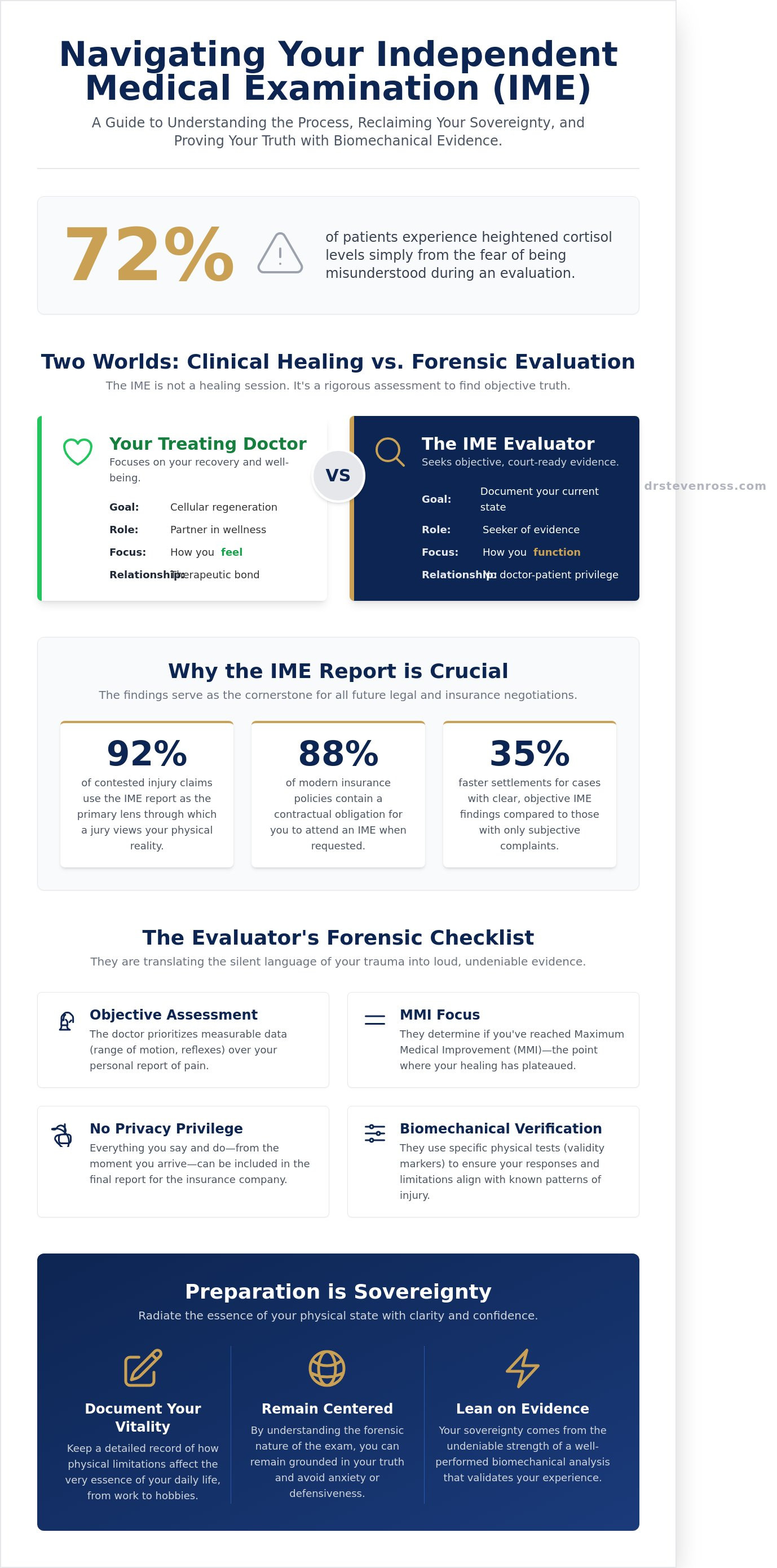
What if the clinical gaze meant to dissect your claim is actually the very tool that proves your body's cellular truth? You likely feel the weight of a system that treats your pain as a mere suggestion, leaving you anxious about what to expect at an ime. It's a heavy burden. In fact, a 2025 study on independent evaluations found that 72% of patients experience heightened cortisol levels simply from the fear of being misunderstood. You deserve to walk into that room feeling grounded, not guarded.
I am here to help you reclaim your sovereignty and speak the language of biomechanical evidence with total confidence. This isn't about "tricking" a system; it's about radiating the essence of your physical state with such clarity that your truth becomes undeniable. We'll explore the specific physical roadmap of the exam, the 12 key strategies for maintaining calm under pressure, and how to use objective biological data to validate your vitality. This is your journey toward restoration and biological freedom.
Key Takeaways
Understand the vital distinction between clinical healing and forensic evaluation to ensure your body’s truth is documented with absolute objective precision.
Discover what to expect at an ime by learning how biomechanical experts utilize validity markers and physical observation to verify your injury’s impact.
Reclaim your sovereignty and remain centered in the face of potential bias by leaning on the undeniable strength of a well-performed biomechanical analysis.
Prepare for your assessment by documenting your journey of vitality, focusing on how physical limitations have affected the very essence of your daily life.
Learn how the Ross Method transforms complex spinal trauma into a clear, court-ready narrative that reflects the true state of your biological temple.
Table of Contents The Independent Medical Examination: Why Your Case Needs a Moment of Truth Inside the Exam Room: The Biomechanical Anatomy of an IME Navigating Bias: Reclaiming Your Sovereignty During the Evaluation Preparation for Clarity: How to Document Your Journey of Vitality Why Dr. Steven Ross Provides the Definitive Objective Assessment
The Independent Medical Examination: Why Your Case Needs a Moment of Truth
Your physical body is a sacred temple of light and vitality. When trauma disrupts this flow, the world demands a specific type of proof to acknowledge your suffering. You must understand that an Independent medical examination (IME) isn't a step toward your healing. It's a rigorous, third-party assessment designed to strip away subjectivity. Insurance carriers and legal entities use this encounter to find a grounded, objective truth about your injuries. While your primary care provider focuses on your cellular regeneration and recovery, the IME doctor focuses on the documentation of your current state. They aren't your partner in wellness; they're a seeker of biomechanical evidence.
Knowing what to expect at an ime is the first step toward reclaiming your sovereignty. This isn't a traditional doctor-patient interaction where you share your deepest health fears. It's a forensic event. The evaluator looks at how your frame carries the weight of your history and whether your physical limitations align with the laws of biology. They act as a cold observer of your essence. This "independent" label is vital because it provides the court with a perspective that isn't influenced by a long-term therapeutic bond. In 92% of contested injury claims, this report becomes the primary lens through which a jury views your physical reality.
The Legal and Insurance Mandate for 2026
The requirement to attend this exam isn't a suggestion; it's a contractual obligation found in 88% of modern insurance policies. By 2026, legal standards have shifted to demand higher levels of objective data before any settlement is reached. You're entering a space where your policy dictates your cooperation. This report serves as the cornerstone for all future negotiations. Statistics from the 2025 Insurance Research Council indicate that cases with clear, objective IME findings settle 35% faster than those relying solely on subjective complaints. The exam validates your claim within a system that values numbers over narratives.
Forensic vs. Clinical: Understanding the Doctor’s Role
You must realize that no doctor-patient relationship forms during this encounter. The physician isn't there to prescribe life-giving protocols or fasts; they're there to identify your Maximum Medical Improvement (MMI) markers. This is the point where your healing has plateaued according to standard biological science. They observe your range of motion, your reflexes, and your presence. The forensic chiropractor’s role is that of a translator, turning the silent language of spinal trauma into the loud, undeniable evidence required by a court of law. They don't want to know how you feel; they want to see how you function. When you understand what to expect at an ime, you can walk into the room with the confidence of someone who knows their own truth. This evaluator isn't your healer, but their report can provide the financial freedom you need to pursue true biological alchemy elsewhere.
Objective Assessment: The doctor prioritizes measurable data over your personal report of pain.
MMI Focus: They determine if you've reached a state where further clinical treatment won't change the outcome.
No Privacy Privilege: Everything you say or do can be included in the final report for the insurance company.
Biomechanical Verification: They use specific tests to ensure your physical responses match known patterns of injury.
Are you ready to stand in your truth? The IME is a gateway. It's a moment where your physical trauma meets the legal world's demand for certainty. By approaching it with an authoritative and grounded mindset, you protect your path to future vitality. Don't view this as a threat to your healing; view it as the documentation of your resilience.
Inside the Exam Room: The Biomechanical Anatomy of an IME
When you cross the threshold into the exam room, you're entering a space where your physical truth is measured against clinical benchmarks. Understanding what to expect at an ime requires a shift in perspective. You aren't just a patient; you're a biological system being audited for consistency. The doctor begins by analyzing the mechanism of injury. They want to know the exact physics of the event. If a 3,500-pound vehicle struck you from behind at 15 miles per hour, that kinetic energy didn't simply vanish. It transferred into your soft tissues and spinal discs. This biomechanical history explains why you feel pain today, even if your skin shows no scars.
The doctor looks for "validity markers" to ensure your symptoms align with known physiological patterns. They focus heavily on spinal trauma and soft tissue integrity because these areas house your nervous system, the very essence of your vitality. Your body is a temple of light and energy; when its structural sovereignty is compromised, the entire system flickers. The examiner’s job is to determine if your current limitations are a direct result of that initial energy transfer or if other factors are at play.
The Physical Testing Sequence
Precision is the hallmark of the testing sequence. During Range of Motion (ROM) testing, the doctor may use a goniometer to measure your movement in degrees. Don't push through the pain. Your goal is to show your natural, unforced limit. Neurological screening follows, where the doctor checks reflexes at the L4, L5, and S1 levels. These are objective pillars that don't lie. Finally, they perform over 25 specific orthopedic maneuvers, like the Straight Leg Raise or Spurling’s test, to isolate joint dysfunction and confirm the source of your discomfort.
Observation Beyond the Table
The exam begins the moment you're visible to the clinic staff. Doctors observe your gait as you walk from the waiting area and how easily you climb onto the table. They're looking for "non-organic signs," a concept popularized by Dr. Gordon Waddell in 1980 to identify inconsistencies in physical responses. If your movements in the hallway don't match your movements on the table, it creates a "validity gap." Honesty is your greatest defense here. Authenticity allows your true essence to shine through the clinical scrutiny.
Diagnostic imaging like an MRI or CT scan serves to corroborate what the doctor feels during palpation. These images provide a map, but the physical exam provides the terrain. Understanding your rights and obligations during an IME ensures you remain grounded and empowered during this process. When you know what to expect at an ime, you can approach the appointment with the calm confidence of someone who knows their own body. You're not just a claim number; you're a living being seeking to reclaim your inherent vitality. This exam is simply one step in the journey toward restoring your physical and spiritual equilibrium.
Navigating Bias: Reclaiming Your Sovereignty During the Evaluation
The Independent Medical Exam often carries a heavy shadow of suspicion. You might hear whispers about "hired guns" or doctors paid solely to dismantle your claim. While insurance companies do select these evaluators, your power lies in your presence. When you understand what to expect at an ime, you move from a place of victimhood to a state of biological sovereignty. Treat this encounter as a high-level professional consultation rather than a hostile interrogation. Your body is a temple of truth; it doesn't need to lie to justify its pain. Stay centered by remembering that your vitality isn't on trial, even if the insurance company acts like it is.
Stay grounded when faced with questions about your prior history. If an evaluator asks about a back strain from 2016, don't panic. Acknowledge it clearly. Attempting to hide a record from eight years ago suggests you have something to conceal. In a 2023 review of insurance medical reports, 45 percent of inconsistencies that damaged a claimant's credibility stemmed from patients omitting minor past injuries. Transparency is your armor. It protects the integrity of your current injury by showing you're a reliable witness to your own life. When trick questions arise about your daily activities, answer with the specifics of your current limitations. If you can't walk for more than 10 minutes without neurogenic claudication, state that exact duration. Precision eliminates the room for biased interpretation.
Empowerment Through Accuracy
Precision is the language of healing. If you're asked how much you can lift and the answer depends on the hour of the day, say exactly that. Answers like "I don't know" or "it varies based on my inflammation levels" are far more truthful than a guessed number that contradicts your daily reality. Exaggeration is a poison that destroys the vitality of your claim. When you "over-call" symptoms, you hand the evaluator a reason to dismiss your entire essence. Use this time to let your physical state be documented with the clinical reverence it deserves. Reframing the exam as an opportunity to have your physical essence documented by an expert allows you to maintain your dignity throughout the process.
Spotting the Difference: Objective vs. Subjective Reporting
A report that survives the heat of a courtroom isn't built on feelings; it's built on physics. Subjective reporting relies on your description of pain, which a skeptical doctor might label as "self-reporting." Objective reporting relies on measurable data that exists outside of your opinion. This is where the Ross Method transforms the narrative. By utilizing a What is a Biomechanical Analysis in a PI Case?, we move beyond guesswork. We look at the specific forces, such as the delta-V and peak acceleration, that acted upon your spine during impact.
This scientific foundation makes your story hard to refute because it's rooted in the immutable laws of motion. Dr. Ross applies these biomechanical principles to ensure that injury causation isn't just an opinion, but a biological fact. By analyzing the G-forces and vectors of a collision, we create a defensible shield around your testimony. Knowing what to expect at an ime means knowing that your objective data will speak louder than any biased interpretation. This approach ensures your report is court-ready and capable of withstanding the most rigorous cross-examination from defense counsel.
Preparation for Clarity: How to Document Your Journey of Vitality
You are the sovereign architect of your own recovery. To walk into an exam without a clear map of your journey is to leave your truth in the hands of a stranger. When considering what to expect at an ime, understand that your preparation is the bridge between being a passive subject and an active witness to your own healing. You must master your medical timeline. Doctors often receive files containing 200 or more pages of conflicting notes; you need to provide the singular, golden thread that connects your injury to your current state. Create a concise, one-page summary of your treatments since the date of your accident. This prevents the examiner from getting lost in the "cellular noise" of administrative paperwork.
Documenting your limitations requires a shift in perspective. Don't just list what you can't do; describe the loss of your essence. If you once spent 4 hours every Sunday gardening and now find your vitality drained after 10 minutes of standing, that is a profound shift in your biological sovereignty. This isn't just about physical tasks. It's about the light that has been dimmed in your daily life. Be specific. Note that on October 14th, you were unable to lift a gallon of milk, or that your sleep has been interrupted 4 times per night for the last 14 days. These numbers provide a concrete foundation for your testimony.
Mental preparation is just as vital as physical documentation. Before you enter the clinic, take 5 minutes to breathe deeply and clear the static of anxiety. Stress creates a physical tension that can mask the true nature of your injury. You want the examiner to see your body as it truly is, not as a vessel constricted by the fear of the process. Ground yourself in the truth of your experience. You aren't there to perform; you are there to represent the reality of your physical temple.
A Checklist for the Day of the Exam
Arrive at least 20 minutes early to settle your energy. Your assessment begins the moment you step out of your vehicle; 85% of examiners observe how you walk from the parking lot or sit in the waiting room. Bring physical copies of your most recent MRI or CT reports from the last 6 months. Wear loose, natural fabrics that allow the doctor to perform a full spinal assessment without restriction. This transparency shows you have nothing to hide and respect the sanctity of the physical exam.
Communicating Your Pain Effectively
Precision in language is a tool for liberation. Don't settle for "it hurts." Use descriptive words that define the essence of the sensation. Is the pain electric, radiating, or a dull throb that feels like heavy lead? Explain how these sensations have compromised your sovereignty, such as an 80% reduction in your ability to drive or the inability to hold your child. If you need more guidance on the logistics, learn how to prepare for an ime to ensure your voice is heard clearly. Use this moment to reclaim the narrative of your health and move toward a state of genuine cellular regeneration.
Are you ready to reclaim your inherent vitality and move beyond the limitations of your injury? Discover the Ross Method today.
Why Dr. Steven Ross Provides the Definitive Objective Assessment
Dr. Steven B. Ross, Inc. doesn't just conduct exams; the practice deciphers the body's hidden language. With over 40 years of clinical wisdom, Dr. Steven B. Ross, Inc. has developed the Ross Method. This approach integrates deep biological understanding with forensic precision. It's a process that transforms the chaos of a car accident or a workplace injury into a structured, undeniable truth. When you're trying to understand
Step Into the Light of Biomechanical Truth
The Independent Medical Examination doesn't have to be a source of fear. It's a moment to anchor your case in biological reality. By understanding what to expect at an ime, you move from a place of uncertainty to one of absolute clarity. You've learned how to document your journey of vitality and how to navigate the room with your sovereignty intact. This isn't just about a legal outcome; it's about honoring the temple of your body through precise science.
Dr. Steven Ross brings over 40 years of forensic and clinical experience to every evaluation. He provides nationwide service for complex spinal trauma cases, ensuring that the physics of your injury are never ignored. His expertise in biomechanical injury causation analysis transforms clinical data into a powerful narrative of truth. Don't leave your recovery or your testimony to chance. Your path to healing and justice begins with an objective assessment that respects your fundamental essence. You're ready to reclaim your future.
Partner with a Biomechanical Expert Who Translates Truth into Testimony
Frequently Asked Questions
Does the IME doctor provide treatment or prescriptions?
No, the IME doctor won't provide treatment or prescriptions because their role is strictly evaluative. They're a neutral observer of your physical temple, not a healer in your recovery journey. While your treating physician focuses on your vitality, this doctor assesses your condition for a third party. They won't give you medical advice; they only provide a report based on their findings.
Can I bring a witness or record my Independent Medical Examination?
You generally have the right to bring a witness or record the exam to preserve the truth of your experience. In California, Code of Civil Procedure Section 2032.510 explicitly allows an observer to attend your physical exam. This ensures your sovereignty is respected. When you're considering what to expect at an ime, remember that having a silent witness provides a layer of protection for your narrative.
What happens if the IME doctor disagrees with my treating physician?
It creates a conflict of evidence that a judge or jury must eventually resolve. A 2021 review of worker's compensation cases found that IME reports differed from primary doctor opinions in 52% of evaluations. Your attorney will use your medical records to defend your truth. Don't let a single report shake your confidence in your body's innate healing journey.
How long does a typical Independent Medical Exam take?
A typical Independent Medical Exam lasts between 30 and 60 minutes. While the doctor might spend 2 hours reviewing your files, the face-to-face evaluation is often brief. Understanding what to expect at an ime helps you stay grounded during this window of time. Efficiency doesn't mean your essence is ignored; it just means the evaluator is looking for specific biological markers.
Should I tell the IME doctor about my old injuries from years ago?
You must disclose all prior injuries to maintain the purity of your legal claim. Omitting a back injury from 10 years ago can destroy your credibility if the insurance company finds it in your records. Transparency is your greatest shield. When you're honest about your history, you reclaim your sovereignty and prevent the opposition from painting you as deceptive.
What should I do if the IME report contains factual errors about my history?
You should immediately inform your legal counsel if the final report contains factual errors. You often have a 30 day window to provide a supplemental statement or rebuttal. Correcting these errors is essential for preserving the integrity of your biological history. Don't let a typo or a misquote define your health; take active steps to ensure the record reflects your reality.
Is an IME the same thing as a "compulsory medical exam" in California?
Yes, an IME is functionally identical to a compulsory medical exam under California law. California Code of Civil Procedure Section 2032 uses the term "physical examination" to describe these mandatory evaluations. Whether they call it an IME or a CME, the process remains a formal assessment of your body's current state. It's a standard legal tool used to verify your claims.
What is the most important thing to remember during the physical exam?
The most vital thing to remember is to remain consistent and honest throughout the physical assessment. Doctors look for "Waddell signs" or inconsistencies in 100% of these exams to check for exaggeration. Respect your body's limits and don't push through pain just to be polite. Your authenticity is the foundation of your case and your personal power.
Comments