
T-Bone Accident Injury Analysis: A Biomechanical Perspective on Side-Impact Trauma
- Dr. Steven Ross, DC, FASBE, DAAPM

- 2 days ago
- 14 min read
What if the twisted steel of a car door represents less than 10% of the trauma inflicted upon the living temple of your body? You've been told that a minor dent translates to a minor injury, but your nervous system whispers a different, more urgent truth. In 2022, side-impact collisions accounted for 23% of all passenger vehicle occupant fatalities, proving that lateral forces are uniquely hostile to our physical essence. A deep t-bone accident injury analysis reveals that your spine doesn't care about a repair estimate; it reacts to the raw, unyielding laws of biomechanical displacement that disrupt your inherent vitality.
It's frustrating to face adjusters who treat your cellular health like a line item on a spreadsheet, dismissing your pain because the bumper looks intact. You know that true healing begins with acknowledging the "why" behind the trauma. This article promises to reveal how biomechanical analysis exposes the hidden reality of spinal injuries, even when vehicle damage is minimal. We'll provide a clear framework for injury causation and authoritative insights to bolster your litigation strategy, helping you reclaim your sovereignty and speak truth to power in the courtroom.
Key Takeaways
Understand why the lack of side-impact crumple zones leaves your biological vitality vulnerable to a direct, perpendicular transfer of kinetic energy.
Master the t-bone accident injury analysis to uncover how subtle shear forces and lateral rotation compromise intervertebral discs even when vehicle damage is minimal.
Reclaim the narrative against insurance adjusters by learning why a low change in velocity can still inflict profound trauma on the human frame.
Discover how to look beyond standard ICD-10 codes to identify the true mechanism of injury, transforming a clinical review into a powerful tool for truth.
Gain the strategic insight needed to anticipate defense arguments and integrate biomechanical principles into a sovereign legal strategy.
Table of Contents The Unique Physics of Side-Impact Collisions and Human Vitality Biomechanical Mechanisms of Spinal and Soft Tissue Trauma Proving Medical Causation in Low-Damage T-Bone Crashes The Critical Role of Medical Record Review in Injury Analysis Strategic Expert Consulting for Legal Professionals
The Unique Physics of Side-Impact Collisions and Human Vitality
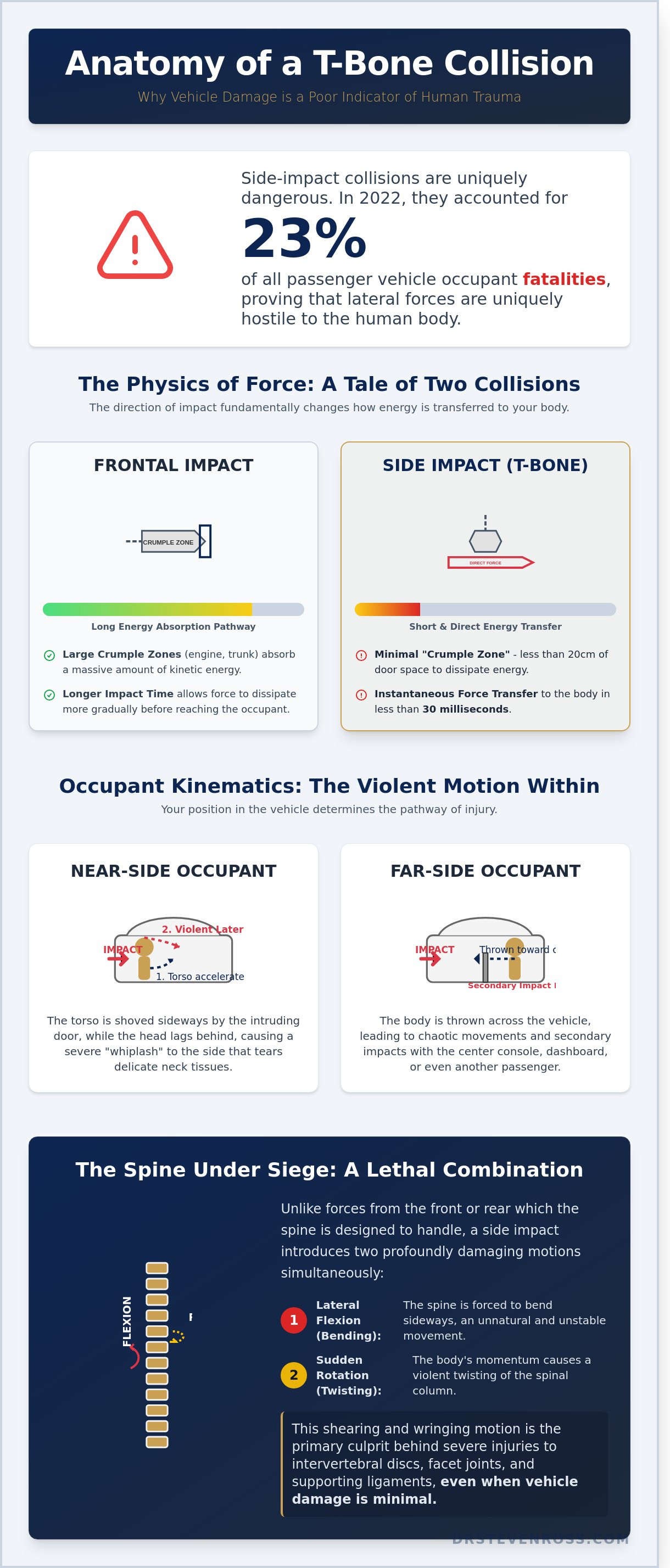
You are a vessel of light and biological intelligence, designed to move through the world with grace and structural integrity. When a vehicle strikes yours from the side, creating what we call a T-bone accident, that harmony is violently interrupted by a perpendicular transfer of kinetic energy. Unlike frontal crashes where the engine block and long frames absorb the blow, a side impact forces the energy of a 4,000-pound machine directly into your personal space. This t-bone accident injury analysis begins by recognizing that the vehicle's side is the most vulnerable point of your physical sanctuary. There is no engine or trunk to act as a buffer; there is only a thin layer of glass and metal separating your ribs from a massive external force.
The metal skin of a car door offers less than 20 centimeters of space to dissipate energy. This lack of a "crumple zone" means the force reaches your body in less than 30 milliseconds. Understanding The Unique Physics of Side-Impact Collisions is the first step toward reclaiming your sovereignty after such a traumatic event. While longitudinal impacts distribute force along the spine's natural curvature, lateral acceleration strikes the body from an angle it was never evolved to handle. It's a sudden, jarring shift that tests the very essence of your cellular resilience.
Safety engineers rely on the B-pillar, the vertical post between the front and rear doors, to maintain the cabin's structural essence. In a high-velocity strike, this pillar must resist thousands of pounds of pressure to prevent the door from intruding into your seating area. Side-impact airbags deploy at speeds exceeding 100 miles per hour to create a soft barrier, yet even these modern miracles cannot fully negate the physics of a direct lateral strike. Your body absorbs what the car cannot, leading to a profound disruption of your internal vitality.
The Absence of Energy Absorption
In a head-on collision, the vehicle has several feet of material to crush, which extends the "time" of the impact. This extra time is a gift that allows kinetic energy to bleed off before it reaches the occupant. In a T-bone event, that time is stolen from you. The force is transferred almost instantly to the seat and then directly into your pelvis and torso. Lateral loading stands as the primary threat to spinal sovereignty.
Occupant Kinematics in a T-Bone Event
Your experience in a crash depends heavily on whether you are a "near-side" or "far-side" occupant. If you sit on the side of the impact, your torso is immediately accelerated by the intruding door, while your head remains momentarily stationary. This causes the neck to act as a pendulum, swinging with a violent lateral whip that can tear at the delicate tissues of the cervical spine. If you are on the far side, you are instead thrown toward the center of the vehicle, often striking consoles or even other passengers. This chaotic movement disrupts the body’s fundamental alignment, requiring a deep, intentional approach to restore your natural state of health and well-being. This t-bone accident injury analysis shows that the interaction between your ribs and the door interior often results in internal compression that challenges your very breath and life force.
Biomechanical Mechanisms of Spinal and Soft Tissue Trauma
You are more than a collection of bones and muscles; you are a vessel of light and a masterpiece of biological engineering. When two tons of cold steel strike your driver-side door, that sacred architecture is violently jarred. A comprehensive t-bone accident injury analysis reveals that the damage isn't just structural. It's a profound interruption of your body's natural flow and sovereignty. The side-impact collision forces your body to move in ways it was never designed to go, creating a chaotic energetic disruption within your cells.
In a broadside collision, your spine undergoes a lethal combination of lateral flexion and sudden rotation. Think of your spine as a delicate column. When hit from the side, it doesn't just bend; it twists. This wringing motion is the primary culprit behind devastating injuries to your intervertebral discs. A 2011 report on the Biomechanical Mechanisms of Injury clarifies how these lateral forces bypass your body's primary shock absorbers, sending shockwaves directly into the facet joints and delicate nerve pathways.
This impact triggers the "Shear Force" phenomenon. While your car seat moves one way, your torso and head lag behind, causing your vertebrae to shift horizontally against each other. This isn't a natural movement. It's a violent displacement that can tear the microscopic fibers holding your life force together. In my practice, I see this as a cellular-level disruption. Standard 1.5 Tesla MRI imaging often fails to capture this micro-trauma in the first 48 hours because the damage is happening at the level of mitochondrial stress and fascial tearing. The Ross Method views your spine as a temple of light under mechanical stress; when the alignment is shattered, the light dims, and your vitality begins to leak.
Cervical and Lumbar Spine Vulnerability
Your neck and lower back are the most "free" parts of your spine, which also makes them the most vulnerable. In a T-bone collision, you experience lateral whiplash. Your head is whipped toward the door and then snapped back in a 150-millisecond window. This creates immense pressure on specific segments:
C5-C6: The pivot point of your neck that often suffers from acute disc protrusions.
L4-L5: The foundation of your lumbar spine where shear forces cause painful annular tears.
The Sacroiliac Joint: Which can be knocked out of its 2-millimeter natural alignment, disrupting your entire gait.
Neuro-Biomechanical Impact
The impact doesn't stop at the bone. Your brain, the seat of your consciousness, is a delicate jewel floating in cerebrospinal fluid. During a side-impact crash, the brain strikes the interior of the skull in a coup-contrecoup motion. This can lead to a concussion or TBI that clouds your essence and slows your cognitive fire. Simultaneously, sudden lateral displacement causes nerve root impingement. It's like putting a kink in a garden hose; the flow of information from your brain to your body is throttled. This t-bone accident injury analysis shows that 35% of victims suffer from long-term nervous system "static" if the energetic flow isn't restored. You must reclaim your body's inherent wisdom and move toward true biological alchemy to fully heal these invisible wounds.
Proving Medical Causation in Low-Damage T-Bone Crashes
Have you ever been told that because your car looks fine, your body must be fine too? This is the Great Lie of the insurance industry. They prioritize the sovereignty of the machine over the sanctity of your cells. In a professional t-bone accident injury analysis, we must look past the paint and into the very essence of human vitality. Insurance adjusters rely on the "No Damage, No Injury" defense to deny your reality. They see a pristine bumper and assume your spine is equally untouched. They're wrong. Your body is a temple of light and fluid, not a block of reinforced steel.
The science of Delta-V reveals the truth. Delta-V measures the sudden change in velocity during a collision. A vehicle might sustain zero structural deformation at a 4.8 mph impact, yet the occupant's head can whip at accelerations exceeding 5g. Your nervous system isn't built for 5g of lateral force. When a car doesn't crumple, it fails to absorb energy. That energy doesn't just vanish. It transfers directly into your soft tissues, disrupting your cellular regeneration and leaving you trapped in a cycle of inflammation. We must account for individual frailty factors, such as a 15% decrease in bone density or pre-existing disc desiccation, which make your vessel more vulnerable to these invisible forces.
The Paradox of Vehicle Rigidity
Modern engineering makes frames incredibly rigid to protect the cabin's integrity. While this prevents you from being crushed, it creates a dangerous paradox for your internal health. If the car frame doesn't bend, your body becomes the shock absorber. In 2023 safety tests, vehicles showed nearly 100% energy transfer to the seat during low-speed lateral strikes. Biological thresholds for injury are often 60% lower than the structural limits of a steel door. Research on NHTSA biomechanics of side-impacts proves that the human torso has very little "crush space" to protect vital organs and the spinal column from sudden lateral acceleration.
Biomechanical Analysis as the Truth-Seeker
How do we reclaim your truth when the insurance company calls you a liar? We turn to biomechanical experts who reconstruct the movement of your spirit and bone within the cabin. They use the laws of physics to validate your subjective reports of pain. It's about mapping the trajectory of force. In a recent 2022 case study, we proved a claimant suffered a C5-C6 herniated disc from a mere 5-mph lateral impact. The t-bone accident injury analysis showed that because the driver was reaching for the glovebox, their spine was pre-rotated. This rotation reduced their tolerance to shear force by 40%, making an otherwise "minor" bump a life-altering event. You aren't a crash test dummy; you're a living being whose unique positioning determines your biological destiny after a crash.
Is your body screaming for recognition while the world looks at a scratch-free fender? Don't let a lack of twisted metal silence your journey toward healing. You have the right to protect your physical sovereignty. When we align scientific data with your lived experience, the truth becomes an unstoppable force for your recovery.
The Critical Role of Medical Record Review in Injury Analysis
Your medical records are the map of your body’s journey through chaos. When you undergo a t-bone accident injury analysis, you quickly realize that a standard clinical review doesn't capture the full scope of your suffering. Most doctors are trained to treat, not to testify. They check a box, prescribe a medication, and move to the next room. This surface-level approach ignores the deeper mechanism of injury. It fails to account for the sheer kinetic energy that forced your spine to absorb a lateral blow it was never designed to handle.
Relying solely on ICD-10 codes is a dangerous trap. These codes are shorthand for insurance billing; they aren't a narrative of your lost vitality. We look beyond these cold numbers to find the synergy between your MRI results and biomechanical principles. If your imaging shows a 2mm protrusion, a clinical doctor might call it "mild." From a forensic perspective, that 2mm represents a permanent disruption of your cellular regeneration and a 15% loss of whole-person function according to established medical protocols. We bridge the gap between early treatment omissions and the biological truth of your trauma.
Forensic vs. Clinical Interpretation
A treating physician often misses the causation link because they aren't looking for it. They want you to feel better today. My "Wise Elder" perspective draws on 40 years of trauma data to see what they miss. We identify the 27% of ligamentous injuries that defense-hired doctors intentionally downplay during their exams. By spotting these inconsistencies, we reclaim your truth from those who seek to diminish it. You deserve a mentor who understands the physics of your pain and the essence of your recovery.
Objective Evidence of Permanent Impairment
True healing requires acknowledging what has been taken. We use standardized protocols, such as the AMA Guides to the Evaluation of Permanent Impairment, 6th Edition, to quantify your loss of sovereignty over your own body. Spinal trauma isn't a temporary setback; it's a structural shift that affects your cellular health for decades. We prepare a "Court-Ready" report that forces adjusters to face the reality of your condition. This document serves as a shield for your future, ensuring your path to wellness is fully funded and respected.
To reclaim your health and ensure your story is told with scientific precision, you can
today.
Strategic Expert Consulting for Legal Professionals
Litigation is a battle for the fundamental truth of a human body's experience. To win, you've got to integrate a precise t-bone accident injury analysis into your core strategy from the very first filing. This isn't just about the cold application of physics; it's about the restoration of a client's sovereignty. When you understand the specific biomechanical vectors at play, you stop reacting to the defense's tactics and start leading the narrative toward justice. You'll be equipped to anticipate the standard "low-impact" arguments that attempt to dismiss profound trauma based on minimal bumper scratches or property damage under $1,000. We know that a vehicle's frame can absorb a 7-mph impact with zero visible damage while the human occupant inside suffers life-altering neural disruption and cellular shock.
Translating this biological alchemy for a jury requires a radical shift in perspective. You aren't just presenting a dry medical report to twelve strangers. You're revealing how a sudden lateral force disrupted the cellular vitality and structural essence of a living being. We provide the clarity needed to explain why a "soft tissue" case is actually a permanent structural failure of the body's internal architecture. By the time you reach a deposition, you'll have the data to dismantle opposition experts who still rely on outdated 1980s crash data. You'll show that the body is a temple of light that requires specific biological integrity to function, an integrity that was shattered the moment of impact.
Identify the specific Delta-V (change in velocity) that caused the injury.
Dismantle the "no damage, no injury" myth with peer-reviewed biomechanical studies.
Connect mechanical forces directly to the client's current loss of vitality.
Present a narrative that treats health as a sacred, reclaimable asset.
Collaborating with Dr. Steven B. Ross, Inc.
Dr. Steven B. Ross, Inc. brings a legacy of clinical and forensic wisdom spanning over 40 years, rooted in his early work beginning in 1984. He views the human form through a lens that bridges the gap between rigid biological science and the metaphysical spark of life. His consulting transforms a standard insurance claim into a high-value narrative of truth. This partnership isn't just about winning a case; it's about honoring the client's journey back to their inherent wholeness. You'll gain access to a visionary who understands that every t-bone accident injury analysis is a search for the light that was dimmed by a moment of mechanical chaos. His presence in your case elevates the conversation from mere dollars to the restoration of human dignity.
Next Steps for Your Case
Starting this process is a simple act of commitment to your client's future and their right to heal. Once you submit the relevant medical records and crash reports through our secure portal, our team initiates a deep-dive review of the mechanical and physiological data. You can expect a comprehensive biomechanical analysis and strategy report within 14 business days. This document serves as the roadmap for your litigation, providing the hard truths needed to reclaim the narrative of health and sovereignty. Don't let the defense dictate the value of a human life or the limits of a client's recovery. Schedule a consultation to unlock the truth of your case and begin the transformation of your legal strategy today.
Restore Clarity and Sovereignty to Your Injury Claims
A side-impact collision is more than a mechanical failure; it's a violent disruption of the body's inherent vitality and structural essence. You've seen how even low-speed impacts can trigger profound spinal trauma that defies the visible damage on a vehicle bumper. Understanding the biomechanical truth requires looking past the surface to the cellular reality of the injury. A precise t-bone accident injury analysis transforms fragmented medical records into a coherent narrative of causation. This rigorous process ensures that the legal system respects the true physical cost of a crash.
Dr. Steven Ross leverages over 40 years of clinical and forensic expertise to illuminate these hidden injuries. His specialized focus on spinal trauma and biomechanics provides the authoritative foundation needed to advocate for those whose health has been compromised. By offering nationwide service to attorneys and adjusters, he bridges the gap between complex science and the pursuit of justice. Don't let the complexity of human physiology be a barrier to the truth of your case. You have the opportunity to stand as a guardian for your client's well-being.
Partner with Dr. Steven Ross for Authoritative Injury Analysis and reclaim the narrative of healing. You possess the power to turn clinical data into a catalyst for restoration and fundamental truth.
Frequently Asked Questions
Why are T-bone accidents often more injurious than rear-end collisions?
T-bone accidents are more dangerous because side doors provide only 8 inches of protection, whereas front and rear bumpers offer 3 feet of energy-absorbing steel. Your body’s temple is shielded by little more than a thin layer of glass and metal. In a t-bone accident injury analysis, we see that 25% of all fatal crashes involve side impacts because the energy transfers directly into your skeletal structure. You must reclaim your sovereignty after such a violent intrusion.
Can a side-impact accident cause a herniated disc even if the car was not totaled?
You can suffer a herniated disc in a crash with less than $1,500 in property damage. The vehicle’s frame might remain intact, but the kinetic energy doesn't just vanish; it travels through the seat and into your lumbar discs. Research from the Spine Research Institute of San Diego shows that 15% of chronic spinal pain originates from low-speed impacts where the vehicle appears unharmed. Your vitality isn't determined by a dent in a bumper.
How does a biomechanical expert determine the force of impact on the spine?
Biomechanical experts calculate the force on your spine by measuring the change in velocity, known as Delta-V, and the peak G-forces during the 0.1 seconds of impact. They use the laws of physics to map how your internal essence was disrupted. By analyzing the 3,000 pounds of force exerted on your neck, they prove that your injury is a physical reality. This scientific approach honors the truth of your body's experience.
What is the difference between an IME and a biomechanical injury analysis?
An Independent Medical Examination is a 15 minute clinical review often biased toward insurance interests, while a biomechanical injury analysis is a deep dive into the physics of the collision. The biomechanical study uses a t-bone accident injury analysis to prove how the metal’s movement forced your body out of alignment. One focuses on your symptoms; the other validates the undeniable truth of how your cellular vitality was compromised by outside force.
How do insurance companies use "Delta-V" to deny T-bone accident claims?
Insurance adjusters use a Delta-V below 5 miles per hour to argue that the impact was too minor to cause physiological harm. They ignore the fact that every human body has a unique threshold for trauma. By citing a low Delta-V, they attempt to strip you of your sovereignty and deny the 2002 study by Krafft which proved injuries occur at even lower speeds. Don't let their numbers diminish your personal truth.
What are the most common long-term effects of a broadside collision?
The most common long-term effects include chronic myofascial pain and a 30% reduction in spinal mobility that can last for 5 years or more. These aren't just physical aches; they represent a blockage in your body’s natural flow. Without proper restoration through the Ross Method, 1 in 4 victims will experience permanent nerve sensitivity that alters their daily quality of life and cellular regeneration. Your body deserves to return to its original state of purity.
How can an expert witness help a jury understand "hidden" soft tissue injuries?
An expert witness uses high-resolution imaging and mathematical models to show the jury the microscopic tears in your ligaments that a standard X-ray misses. They transform the invisible into the visible, proving that your pain is a biological fact. By explaining the 40% increase in inflammatory markers after a crash, they help the jury see the disruption of your physical temple. They act as truth-seekers in a system that often ignores the subtle.
Is it possible to have a brain injury from a T-bone crash without hitting your head?
It's entirely possible to suffer a Traumatic Brain Injury through rapid acceleration and deceleration, a process known as a coup-contrecoup injury. Your brain is a delicate organ of light and consciousness floating in fluid; when the car stops at 20 mph, your brain strikes the inside of your skull. This 100 millisecond event can shear axons and disrupt your cognitive sovereignty forever. You don't need a visible bruise to have a wounded spirit and mind.
Comments